
The main important point is to insure a good coupling between the transducer and the liquid. Any gas interface is not allowed
because gas has a very low acoustic impedance and therefore reflects all the ultrasonic energy.
The best coupling is realized when the transducer is immersed in the liquid. All Signal Processing's transducers can be
completely submerged in any liquid which is not chemically aggressive. The housing of the transducer is made of stainless
steel and the front surface is made of epoxy. Other material for the housing can be also available. When it is not possible
to immerse the transducer and a solid wall has to be crossed, an ultrasonic coupling gel is used.
Normally the transducers are delivered with a standard cable of 1.5 meter, but longer cable can be used. The only requirement
is to use a 50 ohm cable, like any RG174 or RG58 cable. Using a cable longer cable then 10 meters can induce some noise in
the measurement and some loss in sensitivity.
Unfortunately not. There are two main reasons for this. The attenuation of ultrasonic waves is very strong at the frequencies used and it is very seldom to find particles of compatible dimensions that can follow the gas flow. Nevertheless it is possible to measure the velocity of a solid surface if a small gap exists between the transducer and the moving surface (in the order of few centimeters).
Ultrasonic Doppler velocimetry is almost the unique technique that is capable to measure in real time a velocity profile in mud. Despite the high degree of attenuation of mud, successful measurement can be realized up to concentration of sand in the order of 30%.
Ultrasonic Doppler velocimetry was originally developed for medical applications. Our ultrasonic velocimeters have been used for many years in the medical field to investigate blood flows in the venous and arterial system. Signal Processing has obtained the EN46001 certification in order to help our customers to use our equipment in the medical field.
Two types of resolution have to be considered. The first one concerns the dimensions of the sampling volume which is the volume
from which particles contribute to the measurement of a single velocity value. Its lateral dimension (perpendicular to the
ultrasonic field axis) is determined by the shape of the ultrasonic field. Typical values are from few millimeters to few
centimeters. The axial dimension of the sampling volume is fixed by the duration of the emitted burst and the bandwidth of the
receiver. Typical values are in the order of tenth of millimeters to few millimeters.
The other resolution concerns the minimum distance between two adjacent gates. This distance is determined by the sampling rate of the
incoming echoes. Three different situations may appear:
The velocity range is defined by the Doppler equation, which involved three parameters, the emitting frequency, the pulse repetition
frequency and the sound velocity in the liquid. By playing with the first two parameters it is possible to cover a wide range of
velocities, from less than 1 mm/s to few m/s. Both positive and negative velocities can be measured simultaneously. Moreover, an
original technique allows to distribute unequally the range of positive and negative velocities.
All velocity values are given in a signed byte format, which fixes the velocity resolution to 1/128 of the maximum scale. In order
to increase the velocity resolution, the maximum velocity scale can be reduced to 1/2, 1/4 or 1/8 of the maximum velocity
corresponding to the pulse repetition frequency.
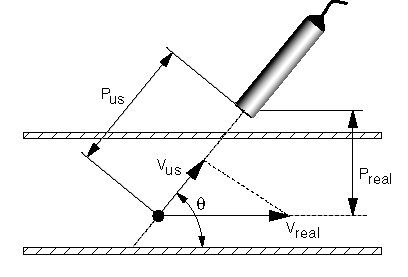
The velocity component measured by the velocimeter is always the component in the direction of the ultrasonic beam (Vus). When the direction of the real velocity is known, the velocimeter can automatically compute the real velocity value(Vreal) by using the value of the Doppler angle(q). In such a case the depth values displayed by the velocimeter are the depths perpendicular to the velocity direction (Preal).
The emitting frequency is directly linked to the resolution. So, in most situation, it is advantageous to select the highest
emitting frequency as possible. Unfortunately, two factors limit the available choice. The maximum velocity that should be
measured (see the Doppler equation) and the attenuation of the ultrasonic waves when they travel through the liquid and the
wall material that have to be crossed.
The attenuation of the ultrasonic waves depends a lot on the emitting frequency and on the type of liquid. High ultrasonic
frequencies are much more attenuated than low frequencies.
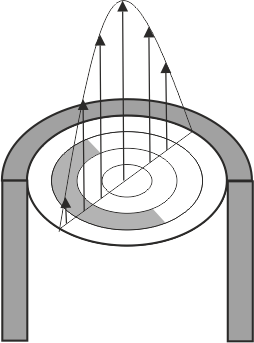
The velocimeter can compute automatically the flow rate when a measuring section is defined. The flow rate is computed by integrating the velocity profile between two user's limits, placed on the velocity profile. These two limits define a section, which is assumed to be circular. The flow rate can be displayed in real time on the screen.
The integration of the velocity profile is realized by adding the contribution of all small subsections, as represented in the figure above. Each subsection has a thickness (e) equal to the gate width and in each subsection the velocity is assumed to be constant and uniform.
Velocity profiles can be measured up to a rate of 300 Hz. But this is not always the case. The acquisition time of a complete profile depends on three parameters:
Yes, the velocimeter can be synchronized to an external event by using its trigger input. The trigger signal can be a low or a high
ogic level (0 or 5 Volt) on the external trigger input or a keyboard action. Moreover after a trigger signal has been accepted,
the velocimeter can wait a user's defined lapse of time and then start the acquisition of data profiles. The delay between the
trigger signal and the acknowledge of the trigger signal can be as low as few microseconds. ("Waiting for" mode).
The smart trigger interface allows to define complex acquisition sequences, with automatic record procedures.
Normally the same transducer is used to emit the ultrasonic burst and to receive echoes. This implies that during the emission
it is not possible to receive any echoes. Moreover, just after the emission, the transducer has to dissipate the amount of energy
that hasn't been send into the liquid. Only after this dissipation it will be able to sense the very small level of the ultrasonic
echoes.
The position of the first measurable gate depends therefore on the emitting frequency, the burst length and the size of the active
element that generates the ultrasonic waves. For instance, at 8 MHz, the first measuring gate can be placed at around 3mm from the
surface of the transducer, which value should be considered as the minimum value.
All displayed data profiles can be recorded to a file in a binary or ASCII format. This means for instance than when both the
velocity profile and the Doppler energy profile are measured and displayed, both data profiles will be recorded. In order to
offer the maximum flexibility, both format can be selected at the same time, which produce two files. Each recorded file contains
a user's reserved area for the introduction of comments.
The binary format does not record only measured data but also record all the values of the functioning parameters. This allows
the execution of any kind of post-processing methods on the original data, and also allows to replay directly on the instrument
or on an external PC any recorded data file.
An accurate time stamp (micro second resolution), the flow rate associated to the velocity profile, an identification byte for the
connected channel and the trigger sequence are attached to all recorded data profile.
Up to 10 different transducers can be connected. During the acquisition process in multiplexer mode, the multiplexer switches from one channel to the other after the measurement of a user's defined number of data profiles. As all the 10 channels are totally independent, each channel can accept different probes and different set of parameters or settings, such as different emitting frequencies, PRF.
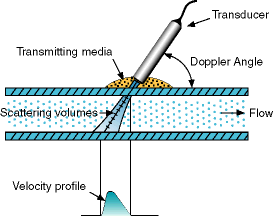
The working principle of the DOP ultrasonic velocimeter is to detect and process many ultrasonic echoes
issue from pulses reflected by microparticles contained in a flowing liquid. A single transducer emits the
ultrasonic pulses and receives the echoes. By sampling the incoming echoes at the same time relative to the
emission of the pulses, the variation of the positions of scatters are measured and therefore their
velocities. The measurement of the time lapse between the emission and the reception of the pulse gives
the position of the particles.
More information ...
The measurement of the velocity is based on the estimation of the mean phase shift of successive echoes
coming from a defined depth. The algorithm used is based on the random statistical nature of each echo.
The algorithm assumes that the statistical properties of all collected echoes used in the computation of
the mean phase shift are stationary. This allows to transform temporal average into spatial average and
to consider all processes stationary.
As the inverse Fourier transform of the probability density function of a stationary process is equal to
the auto-correlation function, the algorithm computes the auto-correlation of the Doppler echoes. The
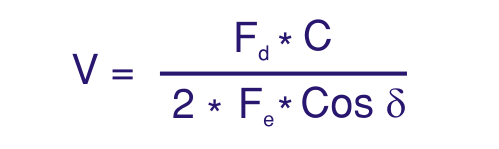
Doppler frequency (Fd) is then computed, and finally the velocity is extracted from Doppler equation:
where (Fe) is the emitted ultrasonic frequency and (C) is the sound speed in the liquid.
The above equation is valid for bi-directional flows having an identical range for the positive
and negative velocities. Our velocimeter allows to select a different range for the positive and negative
velocities. This allows to measure higher velocity than the above defined value, up to two times,
without loss of information concerning the direction of the flow.
Moreover, we have developed a method that extend measuring velocity range.
The velocity component measured by the velocimeter is always the component in the direction of the ultrasonic beam. When the direction of the real velocity is known, the velocimeter can automatically compute the real velocity value by using the value of the Doppler angle.
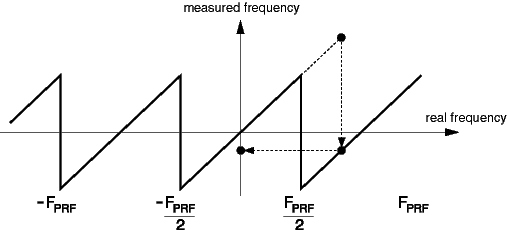
Aliasing is a phenomena that appears when an analog signal is sampled at a frequency which is lower than the half of its maximum frequency. When such a situation appears all the frequencies above the half of the sampling frequency, known as the Nyquist frequency, are back folded in the low frequency region. This phenomena is called aliasing.
To avoid aliasing the analog signal should be filtered before sampling in order to remove all the frequencies
above the Nyquist limit. In pulsed Doppler ultrasound velocimetry the sampling frequency is equal
to the pulsed repetition frequency (PRF). The pulsed nature of the ultrasonic emission implies that only
samples are available. This means that the aliasing phenomena can not be removed, or filtered and may
therefore appears. An easy way to check the presence of aliasing is to examine the evolution of the measured
Doppler frequency when the pulsed repetition frequency is changed.
We have developed a new method that overcomes the aliasing limitation and therefore extends the measuring
velocity range. This new method is based on more then one sampling frequency.
In ultrasonic Doppler velocimetry, the shape and lateral sizes of the sampling volumes (measured
perpendicularly to the ultrasonic beam axis) are defined by the geometry of the ultrasonic beam. The
longitudinal size of the sampling volumes is defined by the burst length and/or the bandwidth of the
electronic receiving unit. Both, the number of emitted cycles and the bandwidth of the receiving unit can
be changed, thus allowing the user to adapt the longitudinal resolution to the application.
The resolution is defined as the distance between the center of adjacent sampling volumes. The very
fast processing capabilities of the DOP instrument allow a minimum distance between adjacent gates to be as
low as 0.12mm in water (133ns). Distance between gates can be adjusted by step of 0.12mm.
The main differences between Laser Doppler velocimetry and ultrasonic Doppler velocimetry can be summarized as followed:
Ultrasonic Doppler velocimetry is a safe technique when applied correctly. The mean ultrasonic power is low, in the order of few milliwatts. The maximum instantaneous power, which is in the order of tens of watts during the emission of the burst, is most of the time not enough to generate cavitation. The only noticed effect is a small local increase of the temperature of the medium under investigation.
Data profiles issue from up to 10 different transducers can be measured sequentially. The user can define the functioning parameters (emitting frequency, PRF, amplification, number of gates,...) for each transducer. The instrument switches automatically from one transducer to the other after the acquisition of a user's defined number of profiles.
Signal Processing's Velocimeters can measure and record not only velocity profiles but also the echoes profiles, the Doppler energy, the flow rate, the power spectrum and of course can record raw data (I and Q signals) for further analysis.
Unfortunately not. There are two main reasons for this. The attenuation of ultrasonic waves is very strong at frequencies in the range of MHz and particles of compatible dimensions that can follow the gas flow are seldom found.
Ultrasonic Doppler Velocimetry is almost the unique technique that is capable to measure in real time a velocity profile in liquids containing a great number of particles, liquid mud. For instance, successful measurements can be obtained in concentrations in the order of 30% for mud and more then 50% in blood.
Signal Processing SA 6 ch. du Cret Rouge 1073 Savigny Switzerland
Tel:+41 21 683.17.17 FAX:+41 21 683.17.18 email: contact@signal-processing.com