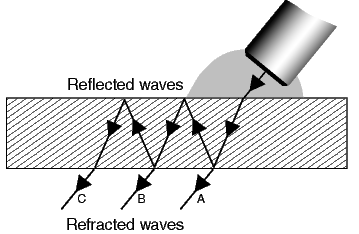


The interfaces reflect and modify the acoustic field. The intensity of the acoustic field received in a point inside the liquid depends on the material, the shape and the number of these interfaces. This intensity is most of the time very difficult to evaluate. This lack of knowledge does not allow a precise determination of the size of the measuring volume.
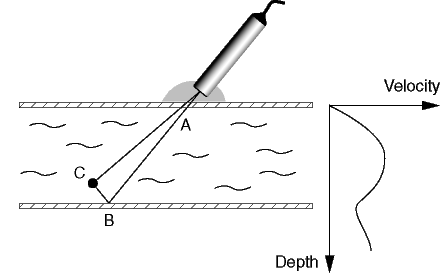
These interfaces may generate, in certain situations, artifacts and induce modifications in the velocity profiles as presented in the figures.
The ultrasonic beam BC reflected by the far interface transforms this interface in a transmitter. The same particles contained in the liquid will backscatter a second time energy in the direction to the transducer. The depth associated to the path ABC is located outside the flowing liquid. Imaginary velocity components are added to the real velocity profile.
The measurement of velocities near the far interface is affected by this phenomena. The size of the ultrasonic beam determines mainly the level of this artifact.