
Technique

Background of UDV

Functioning principles of pulsed Doppler ultrasound

Doppler ultrasonic technique

The Doppler ultrasound technique was originally applied in the medical field and dates back more than 30 years. The use of pulsed emissions has extended this technique to other fields and has opened the way to new measurement methods in fluid dynamics.

The term "Doppler ultrasound velocimetry" implies that velocity is measured by detecting the Doppler frequency in the received signal, similar to Laser Doppler velocimetry. In pulsed ultrasonic velocimetry, however, velocities are calculated from particle displacements between successive pulses, and the Doppler effect plays only a minor role. Many publications, even recent ones, fail to make this distinction, resulting in incorrect system descriptions and misinterpretation of various physical effects.

Animation showing ultrasonic pulse echo detection in liquid

The pulsed Doppler method

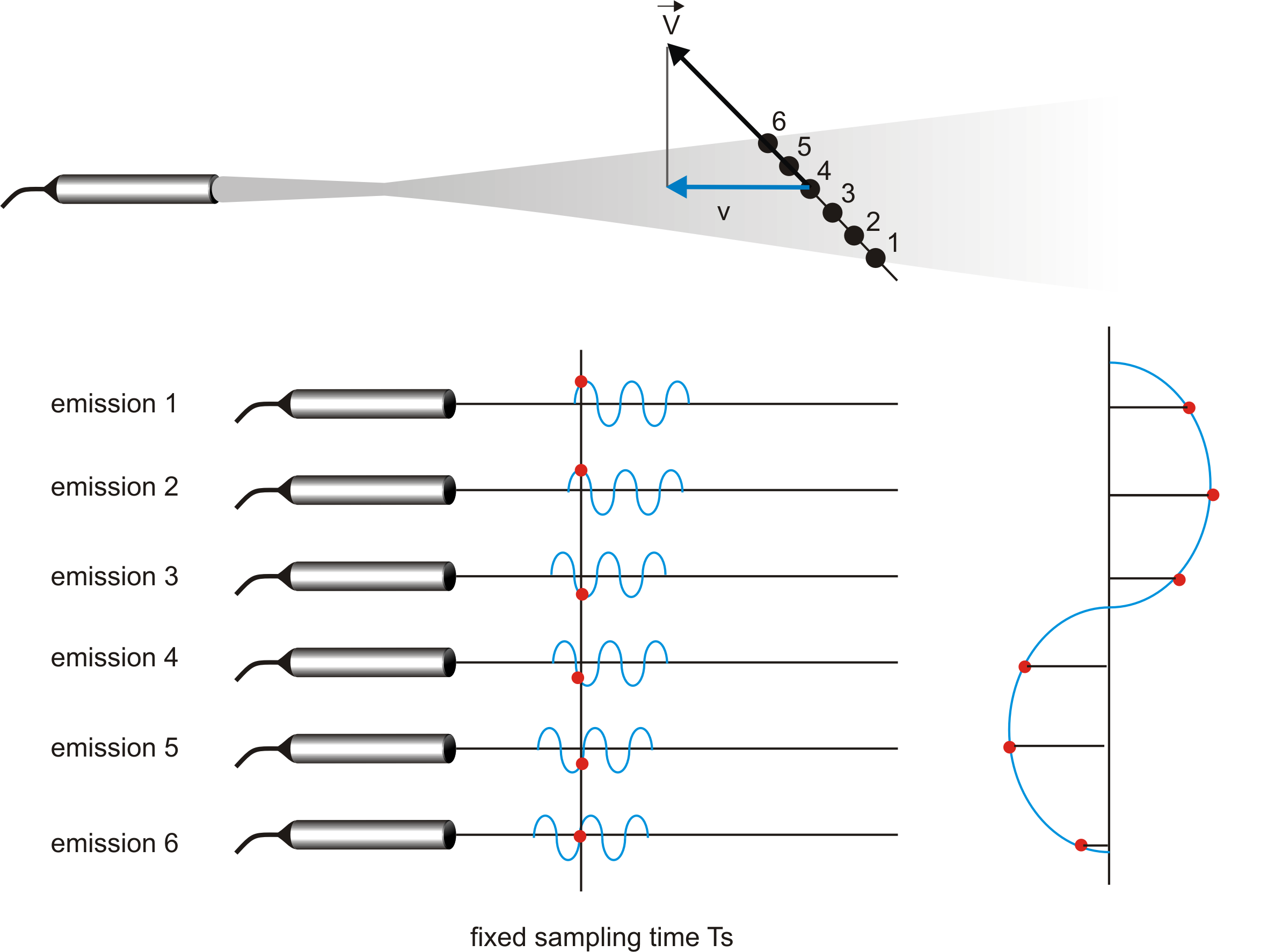
Instead of emitting continuous ultrasonic waves, a pulsed Doppler system sends short ultrasonic bursts periodically, while a receiver continuously collects echoes from particles in the path of the ultrasonic beam. By sampling echoes at fixed times relative to each emission, particle velocities can be computed.

How velocity is measured

Consider a single particle along the ultrasonic beam. At time T1, a pulse is emitted and propagates through the liquid. At time T2, the pulse reaches the particle. If the particle is much smaller than the wavelength, it generates a weak scattered echo back to the transducer, while most of the energy continues forward.

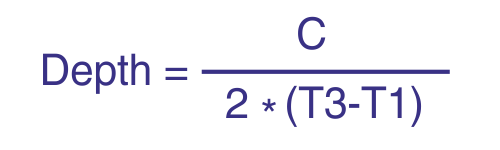
At time T3, the echo returns to the transducer. The particle depth can be calculated from the travel time (T3-T1):

Equation for particle depth based on ultrasound time of flight

where C is the sound velocity in the liquid.

Pulsed bursts are emitted periodically. For each emission, the echo is sampled at a fixed delay, which defines the depth. If the particle moves between successive emissions, the sampled signal values will change over time, potentially forming a sinusoidal waveform.

Multiple ultrasonic emissions showing particle motion over time
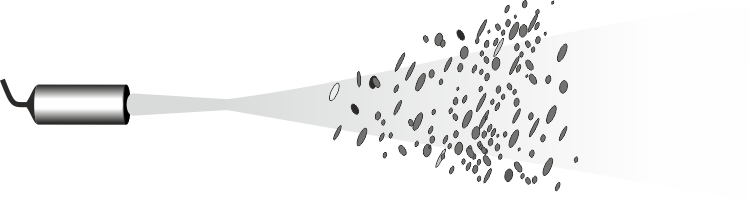
Illustration of multiple particles in the ultrasonic beam

The main equation

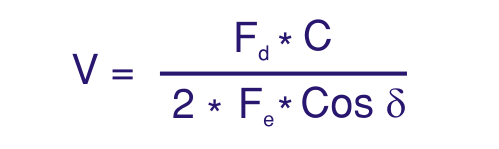
The sinusoidal signal frequency, Fd, called the Doppler frequency, is directly related to the particle velocity by the Doppler equation.

Doppler equation relating particle velocity to frequency shift

In practice, many particles are randomly distributed in the beam. Their echoes combine into a random signal, but correlations between emissions allow algorithms to extract velocity information.

Advantages and limitations

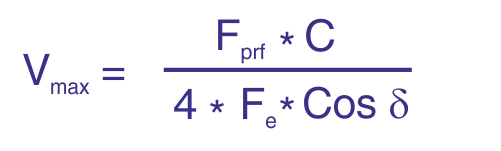
Pulsed Doppler ultrasound provides complete velocity profiles instantaneously. However, since measurements occur periodically, the Nyquist theorem limits the maximum measurable velocity (Vmax) for each pulse repetition frequency (Fprf):

Maximum velocity equation based on Nyquist theorem

The maximum measurable depth (Pmax) is also limited by the pulse repetition frequency:

Maximum depth equation based on pulse repetition frequency

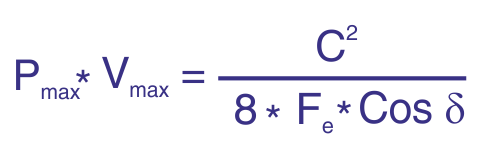
Therefore, the product of Pmax and Vmax is constant:

Constant product of maximum depth and maximum velocity
Illustration showing relationship between Pmax and Vmax
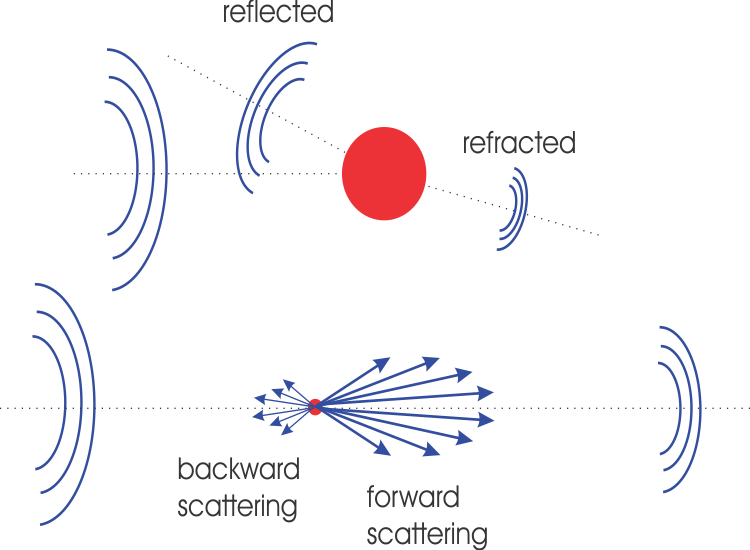
Ultrasound scattering on particles in a fluid

Ultrasound scattering

Ultrasonic waves travel in a narrow cone and interact with particles of different acoustic impedance. Impedance is defined as the product of particle density and sound speed:

Acoustic impedance equation

Particles smaller than the wavelength produce backward scattering, reflecting only a small portion of energy to the transducer. Larger particles reflect and refract the waves, altering direction and intensity. Pulsed Doppler velocimetry relies on particles smaller than the wavelength to avoid significant disturbance of the ultrasonic beam.