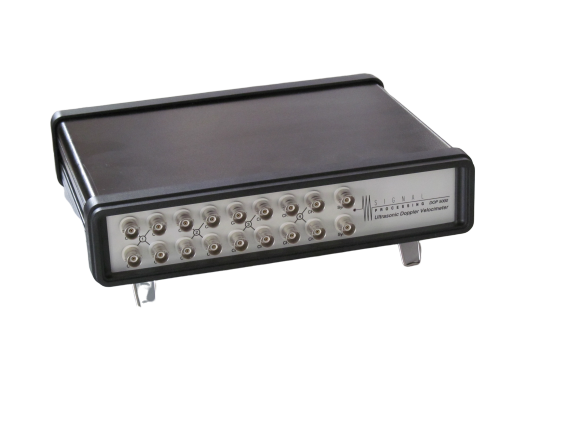
DOP5000 Ultrasonic Doppler Velocimeter and Ultrasonic Velocity Profiler

The DOP5000 is a high-performance pulsed ultrasonic Doppler velocimeter and ultrasonic velocity profiler built for multi-channel velocity profiling and advanced flow diagnostics. With up to 16 channels organized in 4 groups and simultaneous processing of 4 channels per group, it supports sequential, simultaneous, and 2D/3D measurement strategies. The system is optimized for demanding research and industrial applications requiring flexible synchronization, scalable setups, and high-resolution real-time velocity profiles.

Main Technical Features

  • Up to 16 channels, divided into 4 groups
  • Ready for channel expansion
  • Easy synchronization
  • Simultaneous acquisition on 4 channels within each group
  • Excellent 14-bit dynamic range and high sensitivity
  • Compact and lightweight
  • UDV 2D/3D option available
Download the DOP5000 brochure with detailed technical specifications

Plug-and-Play Ultrasonic Velocity Profiler

The DOP5000 connects to an external PC via USB and is controlled through the UDOP software. UDOP is designed to manage multi-channel configurations efficiently, including grouped channel operation and synchronized acquisitions.

Probes can be used in contact with the liquid or positioned outside the container to perform non-intrusive velocity profiling through walls using acoustic coupling gel. This flexibility supports laboratory and industrial setups where intrusive installation is not possible.

Assisted setup helps balance depth range, PRF, velocity range, and profile resolution. For complex experiments, advanced controls and synchronization tools allow repeatable workflows and integration with external triggers and multi-instrument configurations.

High-Resolution Velocity Profiling and Wide Dynamic Range

The time between adjacent measuring points (gates) can be as short as 160 ns and can be increased up to 20 ms in steps of 160 ns. In addition, a velocity profile can contain up to 1000 gates.

The analog processing circuitry provides an excellent 14-bit dynamic range for processing signals containing strong stationary echoes. To obtain optimal resolution and a high signal-to-noise ratio (SNR), the bandwidth of the demodulated signal is set to 250 kHz. This ultrasonic profiler is optimized for velocity profiling with fine gate spacing and stable measurements across a wide dynamic range.

Multichannel Architecture & High Flexibility

  • 16 independent channels organized into 4 groups
  • 4 channels processed simultaneously
  • Supports simultaneous, sequential, and 2D/3D measurements
  • Advanced synchronization capabilities for multi-instrument setups

The 16 channels are connected to a high-speed analog multiplexer, which connects the 4 channels of a group to the analog front end that processes the echo signals simultaneously.

Each channel in a group has its own transmit circuit and its own parameter set.

Key Benefit: Extremely flexible configuration for complex experimental setups.

Flexible Emission Frequency

The DOP5000 can emit an ultrasonic burst at frequencies from 450 kHz up to 10.5 MHz, with a resolution of 1 kHz. This fine adjustment capability optimizes ultrasonic energy transfer when measuring through walls and interfaces.

Synchronization and System Integration

The DOP5000 contains three connectors that can be defined by software as inputs and/or outputs, plus a dedicated external trigger input.

These connectors enable precise synchronization of multiple instruments and support advanced acquisition strategies. Depending on the configuration, signals can include:

  • A pulse at each emission
  • A pulse at each profile acquisition
  • A pulse at each acquisition

High-Sensitivity Ultrasonic Velocity Profiler

Sensitivity is a critical parameter because it influences the application range of the instrument. A highly sensitive instrument enables measurements in liquids containing few particles and/or in liquids with a high attenuation coefficient.

Sensitivity is defined as the minimum instantaneous power of Doppler echoes from which Doppler information can be extracted.

Signal Processing SA has invested significant effort in developing very sensitive instruments. As a result, where many other instruments fail, our ultrasonic Doppler velocimeters and ultrasonic velocity profilers continue to provide reliable, high-quality data.

User Benefit: Accurate measurements even in low-particle or highly attenuating fluids.

Pulsed Doppler Velocity Profiling: How It Works

The DOP5000 uses pulsed ultrasound Doppler velocimetry to measure spatially resolved velocity profiles in liquids. The transducer emits short ultrasonic bursts periodically (defined by the pulse repetition frequency, PRF), and the system collects echoes backscattered by small particles present in the flow. By sampling echoes at precise times after each emission, UDOP determines the depth of each sampling volume (gate) along the ultrasonic beam and computes velocity from the evolution of the demodulated Doppler signal.

Because pulsed Doppler is a sampled measurement, the PRF links two key limits: the maximum measurable depth and the maximum unambiguous velocity (Nyquist limit). The DOP5000 provides assisted setup and fine parameter control to balance depth range, velocity range, and measurement variance. This helps reduce aliasing and supports reliable profiling in demanding conditions.

More information on the working principle

Optimized Measurements Through Walls and Interfaces

Many applications require non-intrusive measurements through container walls. Interfaces can reflect and refract the acoustic field and may create strong stationary echoes or artifacts. The DOP5000 supports frequency fine-tuning (1 kHz resolution) and flexible operating parameters to optimize ultrasound energy transfer and improve measurement robustness when measuring through walls.

UDOP also helps identify artifacts by adjusting PRF and checking whether an echo shifts in depth when PRF changes. This practical workflow reduces the risk of interpreting duplicated echoes as real flow information.

More information on measuring through walls

Real-Time Profiles Beyond Velocity

The DOP5000 does more than compute a velocity profile. UDOP can display complementary real-time profiles that increase confidence in the measurement and provide additional flow insight.

  • Echo modulus profile: monitors the received echo envelope and helps detect strong reflectors and receiver saturation.
  • Doppler energy profile: highlights energy reflected by moving structures using high-pass filtering.
  • Histogram view: shows the distribution of velocity, echo, or energy values along gates in a color-coded display.
  • Velocity vs. time: tracks unsteady behavior at selected depths (gates) for transient or pulsatile flows.

These displays support faster setup, easier troubleshooting, and better interpretation of complex flows (e.g., near walls or in highly reflective environments).

Spectral Analysis: FFT Power Spectrum per Gate

A velocity value shown on a profile is typically based on a mean Doppler frequency. However, a single mean value can hide important information about the distribution of Doppler energy. UDOP can compute an FFT-based power spectrum at a selected gate (from demodulated I/Q signals after high-pass filtering), helping reveal multi-component flows, broadened spectra near walls, and spectral contributions from moving boundaries.

For advanced analysis, UDOP stores both the velocity profile and spectrum data for further post-processing.

More information on how the FFT spectrum can be useful

Flow Rate vs. Time from Measured Velocity Profiles

The DOP5000 can compute flow rate in real time by integrating the measured velocity profile over a user-defined area. UDOP provides interactive wall indicators to define the conduit diameter and the integration limits. This method assumes a circular cross-section and uses the measured profile as a set of semi-annular regions in which velocity is approximated as uniform within each region.

Accurate flow rate estimation requires proper alignment between the pipe axis and the ultrasonic field, as well as an appropriate Doppler angle for converting the beam-axis velocity component into the flow-axis velocity.

Triggering, Recording, and Raw Data Acquisition

The DOP5000 supports internal or external triggering for time-synchronized measurements. UDOP can capture pre-trigger profiles, apply an optional post-trigger delay, and automatically record sequences to file for repeatable experiments and system integration.

For expert users, UDOP also offers raw data acquisition of demodulated I/Q signals after amplification and low-pass filtering. Raw data access enables custom signal processing, validation workflows, and advanced research use cases.

Cleaner Visualization with Real-Time Filters

UDOP provides real-time display filters to improve the readability of profiles without altering the stored data. A moving average filter reduces variance, and a median filter is especially effective at rejecting random spikes when operating at high sensitivity.

This approach preserves the integrity of recorded profiles for later replay and post-processing, while offering a clearer live view during setup and acquisition.

Sound Speed Measurement for Improved Calibration

The instrument can measure the sound speed in a liquid by timing an ultrasonic burst over a known reference distance. Using the correct sound speed improves depth calibration and overall measurement accuracy, especially when working with temperature-dependent liquids or non-standard fluids.

Aliasing in Pulsed Doppler Velocimetry

In pulsed ultrasonic Doppler velocimetry, the maximum measurable velocity is limited by the pulse repetition frequency (PRF). According to the Nyquist criterion, Doppler frequencies above half the PRF are folded back into the measurable frequency range. This phenomenon, known as aliasing, results in incorrect velocity values, often appearing as abrupt sign changes or artificially low velocities in the profile.

Aliasing typically occurs when the selected velocity scale is too small for the actual flow velocity, or when the PRF is not properly adjusted to the measurement conditions. Because pulsed Doppler systems only sample echoes periodically, it is not possible to remove aliasing by filtering, unlike in continuous-wave systems.

Advanced Aliasing Correction Methods in the DOP5000

The DOP5000 provides intelligent tools to minimize and correct aliasing effects. The first strategy is to select an appropriate PRF based on expected velocity values. Assisted mode helps users start with a high PRF and progressively adjust measurement depth and velocity scale to avoid ambiguity.

For more demanding applications, the DOP5000 supports automatic aliasing correction algorithms, including:

  • Jump method correction: detects abrupt velocity discontinuities and reconstructs the true velocity by adding or subtracting PRF multiples.
  • Two-PRF method: combines measurements acquired at two different PRF values to resolve ambiguity and extend the measurable velocity range.

These advanced correction techniques significantly increase the usable velocity range while preserving spatial resolution. They are particularly valuable in turbulent flows, high-speed pipe flows, and rotating systems where velocity gradients can exceed the nominal Nyquist limit.

A practical way to detect aliasing is to slightly modify the PRF and observe whether velocity values shift abruptly. If the measured Doppler frequency changes disproportionately with PRF variation, aliasing is present.

More information on how the aliasing correction works

Raw IQ Signal Acquisition for Advanced Analysis

For advanced research and signal processing applications, the DOP5000 allows direct acquisition of the demodulated in-phase (I) and quadrature (Q) Doppler signals. These raw IQ signals are captured after amplification and low-pass filtering (200 kHz cutoff), providing direct access to the fundamental Doppler information used to compute velocity profiles.

Up to 16,380 pairs of I/Q samples can be recorded, each stored as a 16-bit signed integer. Users can define the number of gates and the number of emissions to acquire, enabling flexible data collection strategies for both transient and steady-state flow investigations.

Why Access Raw Doppler IQ Data?

While standard velocity profiles are computed from the mean Doppler frequency, the raw IQ signals contain the complete phase and amplitude evolution of the backscattered ultrasonic wave. Access to these signals enables:

  • Custom Doppler frequency estimation algorithms
  • Advanced FFT and spectral analysis
  • Validation of signal processing models
  • Research on turbulence and multi-component flows
  • Development of proprietary post-processing techniques

The evolution of IQ signals across successive emissions reflects the motion of scatterers inside the sampling volume. Their phase progression is directly related to velocity, while amplitude fluctuations provide information about particle distribution and beam geometry.

Raw data acquisition is available when assisted mode is disabled, ensuring full manual control over PRF, sensitivity, resolution, and emission parameters. This capability makes the DOP5000 not only a measurement instrument but also a powerful experimental platform for ultrasonic Doppler research.

More information on the demodulated echo signals

Applications

  • Laboratory fluid mechanics and turbulence research
  • Hydrodynamic studies and sediment transport measurements
  • Industrial flow diagnostics and process optimization
  • Environmental and geophysical fluid dynamics
  • Multiphase and particle-laden flow analysis

Frequently Asked Questions

How do the 16 channels operate on the DOP5000?

The DOP5000 provides up to 16 channels organized in 4 groups. Within a group, 4 channels are processed simultaneously, enabling flexible measurement strategies across multiple probes.

Can I synchronize the DOP5000 with other instruments?

Yes. The DOP5000 supports advanced synchronization using software-configurable I/O connectors and a dedicated external trigger input, which is useful for time-aligned acquisitions and multi-instrument systems.

Is the DOP5000 suitable for 2D/3D flow measurements?

Yes. With the appropriate UDV 2D/3D option and probe configuration, the DOP5000 supports advanced 2D/3D measurement strategies for research-grade flow diagnostics.

What is the benefit of multi-channel profiling in practice?

Multi-channel capability allows simultaneous measurements at different locations or angles, faster mapping of complex flows, and better repeatability in experiments where conditions evolve over time.