
Technique

FAQ

Frequently Asked Questions

On UDV applications

How should ultrasonic transducers be installed?

It is essential to ensure good coupling between the transducer and the liquid. Any gas interface must be avoided, as gas reflects almost all ultrasonic energy due to its low acoustic impedance.

Immersion of the transducer in the liquid provides the best coupling. Signal Processing's transducers can be fully submerged in any chemically compatible liquid. The transducer housing is stainless steel, and the front surface is epoxy.

If immersion is not possible and a solid wall must be crossed, use an ultrasonic coupling gel.

Standard cables are 1.5 m long, but longer cables can be used provided they are 50 Ω (e.g., RG174 or RG58). Cables longer than 10 m may introduce noise and reduce sensitivity.
Is it possible to apply UDV in gas?

In general, no. Ultrasonic waves are strongly attenuated in gases at the frequencies used, and particles of suitable size are rarely available to follow the flow. However, it is possible to measure the velocity of a solid surface if the transducer is placed a few centimeters from it.

Can mud flows be measured?

Yes. Ultrasonic Doppler velocimetry is one of the few techniques capable of measuring real-time velocity profiles in mud. Measurements can be performed successfully even with sand concentrations up to 30%.

Can blood flows be measured?

Yes. UDV was initially developed for medical applications and has been used extensively to measure blood flows in venous and arterial systems. Signal Processing is EN46001 certified for medical applications.

On DOP features

What about spatial resolution?

Spatial resolution has two aspects:

  • Lateral and axial dimensions of the sampling volume, determined by the ultrasonic beam shape and burst duration. Lateral: mm–cm, Axial: 0.1–mm–mm.
  • Distance between adjacent gates. It can be smaller than, equal to, or greater than the sampling volume thickness, affecting overlap or dead zones.

What about the velocity range and resolution?

The velocity range depends on the emitted frequency, pulse repetition frequency (PRF), and sound speed. Both positive and negative velocities can be measured. Resolution is fixed by the signed byte format (1/128 of max velocity), but can be improved by adjusting the scale factor.

Which velocity component is measured?

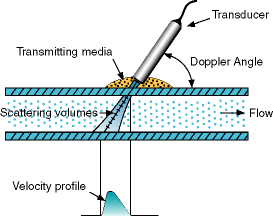
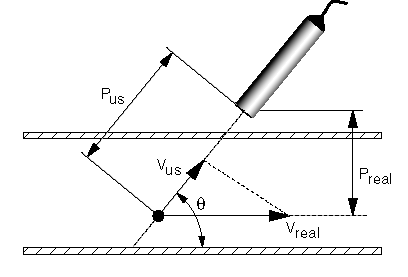
The measured component is always along the ultrasonic beam. If the real velocity direction is known, the instrument can compute the true velocity using the Doppler angle.

How to choose an emitting frequency?

Higher frequencies provide better resolution but are more strongly attenuated. Consider maximum measurable velocity and attenuation when selecting frequency.

How is the flow rate computed?

Flow rate is computed by integrating the velocity profile across a defined section. Limits can be set interactively, and the section is assumed circular.

How fast can a velocity profile be measured?

Measurement rates can reach 500–300 Hz, depending on sound speed, maximum depth, and number of emissions per gate to reduce statistical variance.

Can the velocimeter be synchronized?

Yes, using external trigger input or keyboard action. Smart trigger interface allows complex acquisition sequences with precise delays.

How close to the transducer can a measurement be made?

Minimum distance depends on emitting frequency, burst length, and transducer element size. For example, at 8 MHz, the first measurable gate is ~3 mm from the transducer.

How are measured data recorded?

Data can be recorded in binary or ASCII formats, with time stamps, flow rates, trigger info, and measurement parameters. Binary format allows post-processing and replay in UDOP software.

How many transducers can be connected?

Up to 10 transducers for DOP3010 and 4 for DOP4000. Each channel can have different parameters, and acquisition can switch automatically between channels.

On UDV technique

How does pulsed Doppler ultrasound work?

The velocimeter detects many ultrasonic echoes from particles in the liquid. The transducer emits pulses and receives echoes. Particle displacement between pulses determines velocity, and time-of-flight gives particle position.

More information...
How is velocity computed?

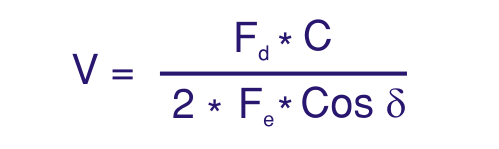
Velocity is estimated from the mean phase shift of echoes at a defined depth. The algorithm uses autocorrelation of Doppler echoes to extract the Doppler frequency, then computes velocity using:

where Fe is the emitted frequency and C is sound speed in liquid. Advanced methods correct aliasing and extend velocity range.

Which velocity component is measured?

Only the component along the ultrasonic beam is measured. The true velocity can be calculated if the Doppler angle is known.

What does aliasing mean?

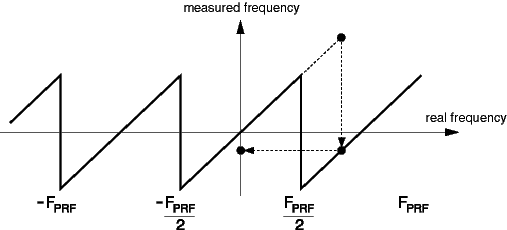
Aliasing occurs when the signal is sampled below twice its maximum frequency (Nyquist limit). In pulsed Doppler, sampling = PRF, so aliasing may appear. Examining Doppler frequency changes with PRF can detect it. Methods exist to automatically correct aliasing.

What is the smallest achievable spatial resolution?

Lateral sizes are defined by the beam; longitudinal by burst length and receiver bandwidth. DOP instruments can have adjacent gates as close as ~0.1 mm in water.

Differences between UDV and Laser Doppler techniques?

Key differences:

  • LDV measures velocity perpendicular to light beam; UDV along ultrasonic beam.
  • LDV measures single particles; UDV measures mean velocities of many particles.
  • UDV has max velocity limits; LDV does not.
  • UDV works with high particle concentrations and opaque liquids; LDV does not.
  • UDV provides full velocity profiles; LDV does not.

How safe is UDV?

UDV is safe. Mean ultrasonic power is a few mW. Peak power during bursts is tens of W, generally insufficient to cause cavitation. Only minor local heating occurs.