Ultrasonic Velocity Profiler

Velocimeter Products

Our velocimeters use pulsed ultrasonic emissions for Doppler measurement of liquid velocity, including opaque fluids. The method is non-intrusive and provides simultaneous measurements across multiple channels from 0.01 mm/s to 10 m/s.

We specialize in Doppler velocimeters using the correlation between successive echoes, known as pulse pair processing, allowing high-frequency velocimetry to convert echoes directly into velocity profiles in milliseconds.

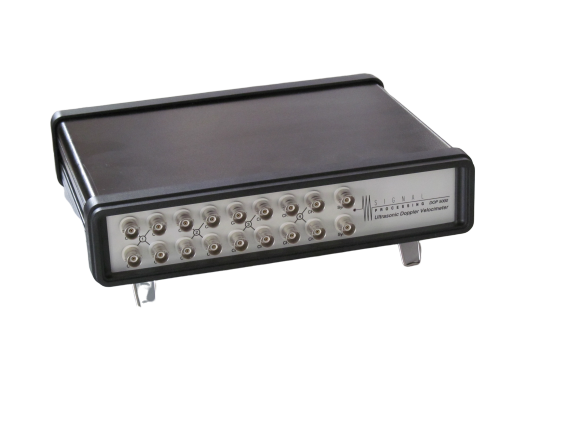
DOP 5000 + UDOP incl.

  • Up to 16 channels, divided in 4 groups
  • Ready for channel extension
  • Easy to synchronize
  • Simultaneous acquisition on 4 channels per group
  • Excellent dynamic range and sensitivity
  • Compact and lightweight
  • UDV 2D/3D option available

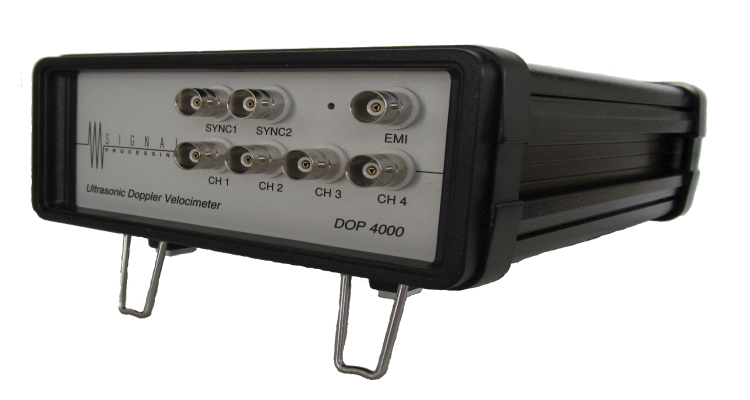
DOP 4000 + UDOP incl.

  • Small, sturdy, compact and lightweight
  • Reduces influence of stationary echoes
  • Easy to synchronize
  • Simultaneous acquisition on 4 channels
  • UDV 2D/3D option available

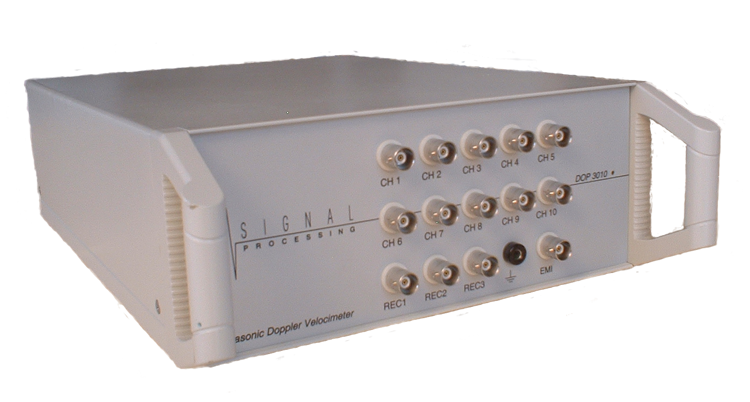
DOP 3010 + UDOP incl.

  • 10 channels integrated multiplexer
  • Ultrasonic synthesizer, 0.45 MHz – 10.5 MHz
  • 5 different spatial resolutions
  • UDV 2D/3D option available

Doppler Ultrasonic Technique

Why Work With Us?

Signal Processing SA develops instruments for scientists working in advanced labs, primarily in fluid mechanics. Our tools offer velocity profiling rather than single-point measurements, capturing data in milliseconds with spatial resolution as small as 1 mm³.

Measurements are non-intrusive and can be performed in opaque liquids, unaffected by magnetic fields. Velocity can be measured in uni-, bi-, and tri-directional modes with flexible acquisition, conditional triggering, and automatic recording.

Contact
Ultrasonic velocity profiler in laboratory
Ultrasonic velocity measurement system

With our user-friendly UDOP software, you can manage each ultrasonic velocity profiler, fine-tuning every operation and parameter to meet your requirements.

Ultrasonic velocimeters overview

Signal Processing SA: Pioneering Ultrasonic Measurements

Founded in 1990 as a spin-off from EPFL, Signal Processing SA is based in Savigny, Switzerland. We develop innovative ultrasonic instruments for advanced laboratories, including UVP, UDV, ADCP, and highly sensitive transducers.

Our commitment ensures customer success with high technical expertise, rapid responses within one business day, real-time online support, and comprehensive documentation for all users.

FAQ

What types of fluid can be measured with a UVP or UDV?

Ultrasound travels in most liquids but not in gas. Our systems can measure both translucent and opaque liquids.

What is the lifespan of a UVP or UDV?

The lifespan is over 20 years with ongoing technical assistance.

What are the costs associated with a UVP or UDV?

The extended costs include the purchase of transducers, approximately €1,000 each. No licensing fees. Software updates are free.

How works the ultrasonic velocity profile method?

The ultrasonic velocity profile method is used to measure the velocity of liquid flow within a given volume. Utilizing the ultrasonic Doppler method, this technique allows researchers and engineers to capture a detailed profile of velocity across a cross-section of a fluid. By emitting ultrasonic waves into the liquid, changes in frequency caused by the Doppler effect are analyzed to determine the speed of particles within the flow.

This profiling is particularly useful in complex fluids and non-Newtonian fluids, where traditional single-point measurements may fail to provide a comprehensive understanding of the flow dynamics. The average velocity can be calculated along various lines within the measurement volume, offering insight into both laminar and turbulent flow conditions.

One significant advantage of the ultrasonic velocity profile method is its ability to operate in transparent and opaque liquids, making it suitable for a wide range of applications, including environmental monitoring and industrial installations. The system can provide real-time data, ensuring that engineers can monitor and control processes effectively.

The methodology employed allows for a precise measurement of velocity with an excellent signal to noise ratio, enabling the detection of subtle variations in flow. This is critical in fields where maintaining accurate flow rates is essential for process control. Additionally, the system can also identify negative values when necessary, which can indicate reverse flow or other anomalies.

What does a sound velocity profiler do ?

A sound velocity profiler is an advanced device designed for measuring the velocity of liquid flow in various environments, particularly where conventional methods may encounter limitations. This system employs the principles of ultrasound to create a non-intrusive measurement technique that avoids disturbing the fluid being analyzed.

By utilizing ultrasonic waves, the device can measure how fast particles are moving within the liquid. This process involves sending sound waves through the fluid and analyzing their reflections based on the movement of particles. The data collected allows for visualization and analysis of flow patterns, enabling engineers to determine how liquids behave under different conditions.

In practical applications, the sound velocity profiler is capable of measuring liquid flow simultaneously at multiple points within a given diameter, thus providing comprehensive data across an entire cross-section of a pipe or system. This capability is particularly beneficial when dealing with harsh environments, where traditional sensors may fail or provide inaccurate readings due to physical interference.

The data obtained from these measurements can be utilized in various fields, such as experimental studies of fluid dynamics, research on non-Newtonian fluids, and optimization of industrial processes. Engineers can use this information to adjust parameters for improved efficiency, enhance product quality, and ensure compliance with safety standards.

Furthermore, the device allows for flexible data acquisition, including advanced conditional triggering and automatic recording. This adaptability makes it suitable for a wide range of field applications, providing crucial insights for process control in industries ranging from chemical manufacturing to energy production.

In summary, a sound velocity profiler is an essential tool for precise velocity measurement of liquid flow, offering significant advantages in accuracy and functionality across diverse applications. Its ability to operate effectively in challenging conditions underscores its importance in modern engineering practices.